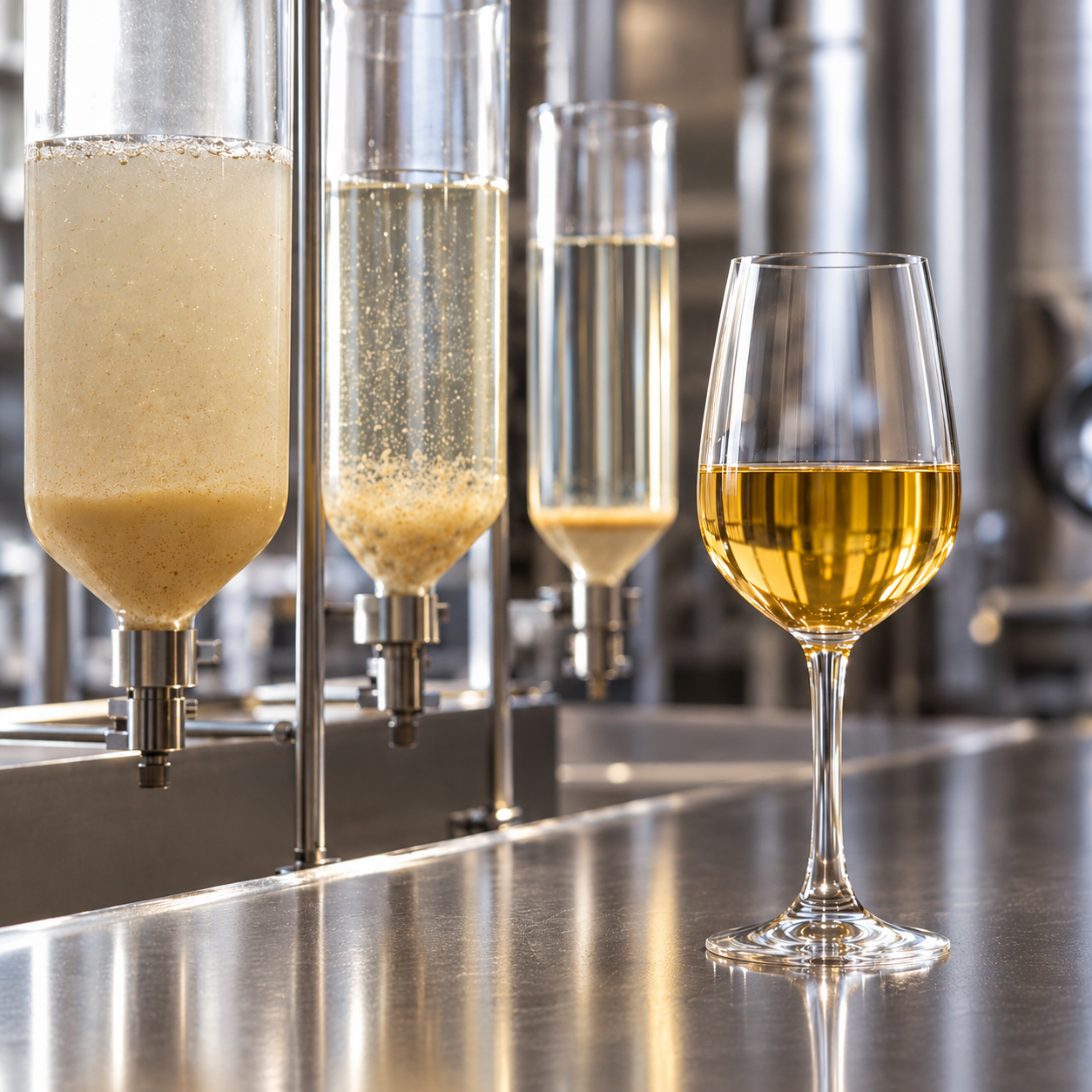
When discussing the visual characteristics of a wine, clarity is one of the aspects that must be carefully monitored during its production. Throughout the various stages of the process, certain particles and suspended substances may remain in the wine.
Its presence forms part of the wine’s own development and composition, but it must be controlled in order to achieve the desired clarity and stability in the final product.
This is where clarification comes into play.
HOW IS WINE CLARIFIED?
Clarification is a process designed to facilitate the separation of certain substances that are in suspension in the wine.
Various methods and clarifying agents can be used to carry out this process. The choice will depend on the characteristics of the wine, its composition and the desired result; therefore, there is no single way of carrying out this process.
Put simply, clarification can be understood as a process that enables certain particles present in the wine to clump together. Once they have clumped together, these particles can then be separated, resulting in a clearer wine.
Suspended particles → clumping → separation → clearer wine
THE AIM OF CLARIFICATION
The main purpose of this process is to improve the clarity of the wine and enhance its stability.
The aim is to produce a wine with a clean, uniform appearance that retains its characteristics throughout storage. Clarification is therefore part of the process of preparing the wine for its final presentation.
CLARIFICATION AND FILTRATION: WHAT IS THE DIFFERENCE?
Clarification and filtration are both involved in winemaking, but they are not the same process.
CLARIFICATION helps to separate certain suspended substances using various methods. The most common approach is to add positively and negatively charged agents so that they interact with one another and draw out any particles that may be suspended in the wine, causing them to settle at the bottom.
FILTRATION, on the other hand, involves passing the wine through a filter medium that retains certain particles and clarifies the wine.
Therefore, each process works in a different way. These procedures are not mutually exclusive: they can and should complement one another.
A CLARIFICATION PROCESS TAILORES TO EACH WINE
Not all wines have the same characteristics, nor do they have the same requirements during the winemaking process. For this reason, they are not all clarified in the same way.
The procedure depends on factors such as the wine’s characteristics, its composition and the desired outcome. Clarification therefore requires the process to be tailored to each batch, rather than applying a single formula.
Clarification is one of the various processes involved in winemaking and must be adapted to the characteristics of each product. To this end, it is essential to have the necessary technical resources and to ensure proper control at every stage.
TECHNICAL RESOURCES AND EXPERTISE FOR EVERY PRODUCTION PROCESS
At Bodegas Mamerto de la Vara, we have the necessary technical facilities, as well as our own laboratory and a team of specialist oenologists. In addition to these resources, we have over 85 years’ experience in producing sweet wines , which enables us to assess the characteristics of each product and adapt the various processes to its specific requirements.
This combination of knowledge, experience and technical resources translates into a flexible and bespoke approach, applicable to the various specialities of our winery, such as: Muscat, mistelle, vermouth, fortified wines, dessert wines, liqueur wines and bespoke sweet wines, always in accordance with the product’s characteristics and each client’s specifications.